
At Saint Gallery, Ibiza, Irina Saint interviewed me about several of the themes that run through my painting: desire, the female body, fantasy, eroticism, and the reaction these works awaken in those who contemplate them.
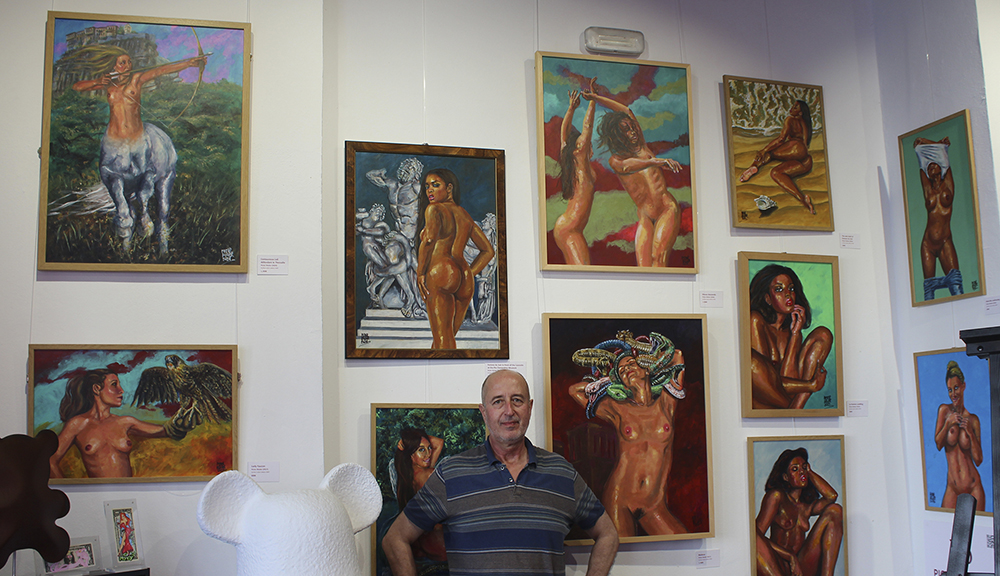
The conversation was brief, yet it touched on essential matters: why I paint nude women, what the female body represents for me, whether I seek to provoke the viewer, and what I hope may occur when someone pauses before a painting.
In this article, I gather and arrange those ideas.
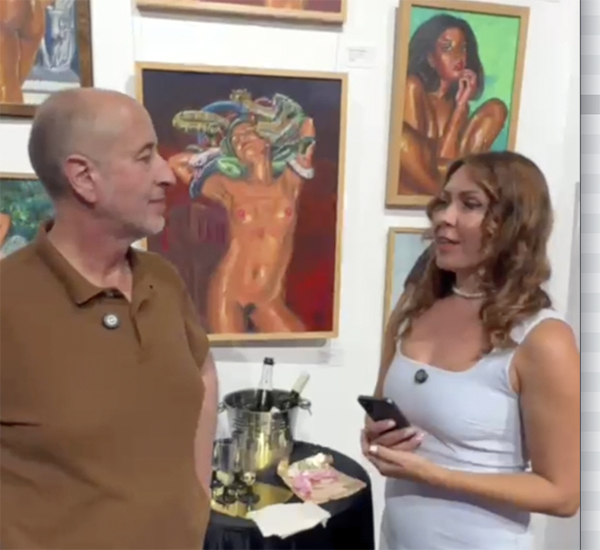
I do so as a way of clarifying the meaning of a body of work that moves between sensuality, the projection of fantasies, and the intimate experience of the beholder.
What inspires me to paint nude women
In the interview, I answered with a deliberately simple phrase: what inspires me is desire, my own and that of the women themselves. I did not wish to embellish it, because in truth that is where the core of many of these paintings lies.
The nude, in my work, does not arise from a will to scandal, nor from a cold academic citation, nor from a merely formal exercise. It arises from desire understood as an imaginative force: an energy that is not confined to erotic impulse, but opens the possibility of embodying a fantasy, a mask, an intensified version of oneself.
That is why the female body appears in my painting not as a mute object, but as a symbolic territory. Each figure contains a tension between physical presence, imagination, and narrative.
Flesh does not cancel the idea: it reveals it. Nudity does not impoverish meaning: it exposes it.
What the female body represents in my work
I also said in the interview that each body represents a fantasy, either mine or the model’s own. This statement requires precision. It does not mean that all the works respond to the same mechanism, nor that they all proceed from the same imaginary world. Rather, it means that each painting has its own story, and that the painted body is, in each case, the visible form of a concrete desire.
At times, that fantasy is shaped through the mythological. At others, through the ritual. At others still, through a more intimate, more delicate, or more playful world of suggestion. What matters is that I do not represent the body as mere anatomy, but as the incarnation of a desire to be, to appear, to play, to expose oneself, or to recognize oneself.
In this sense, the female figure interests me because it admits an extraordinary visual and symbolic complexity. It can be at once vulnerable and sovereign, sensual and mental, earthly and fabulous.
Medusa: eroticism, myth, and pictorial singularity
One of the works mentioned in the interview was Medusa. I explained then that the model wanted me to paint her as a mythological being, that I chose Medusa, proposed it to her, and she agreed. I added a detail to which I attach particular importance: it is a singular painting because, as far as I have found, there is no other representation of Medusa in the history of art in which all the snakes are different and, moreover, correspond to real species.

That zoological precision is not an ornamental whim. It introduces a particular density into the image. For centuries, Medusa has been a figure burdened with masculine projections: monster, punishment, threat, petrifying fascination. In my painting, without ceasing to be powerful, she retains an erotic dimension that does not exclude mystery. The real snakes reinforce the corporeality of the myth: they prevent the fabulous from drifting away from the world and instead make it adhere to it with a strange verisimilitude.
When the mythological works, it does not serve to flee from the flesh, but to return to it with greater intensity. In Medusa, desire and danger do not contradict one another. They brush against each other. They entwine. They justify one another.
Leina and fantasy as a form of revelation
Another of the works mentioned was Leina Hada de los Bosques, situated in a realm of fantasy. The painting shows a nude female figure, with translucent wings, in an environment of dense vegetation and water, as though the body were emerging at once from the forest, from reflection, and from fable.
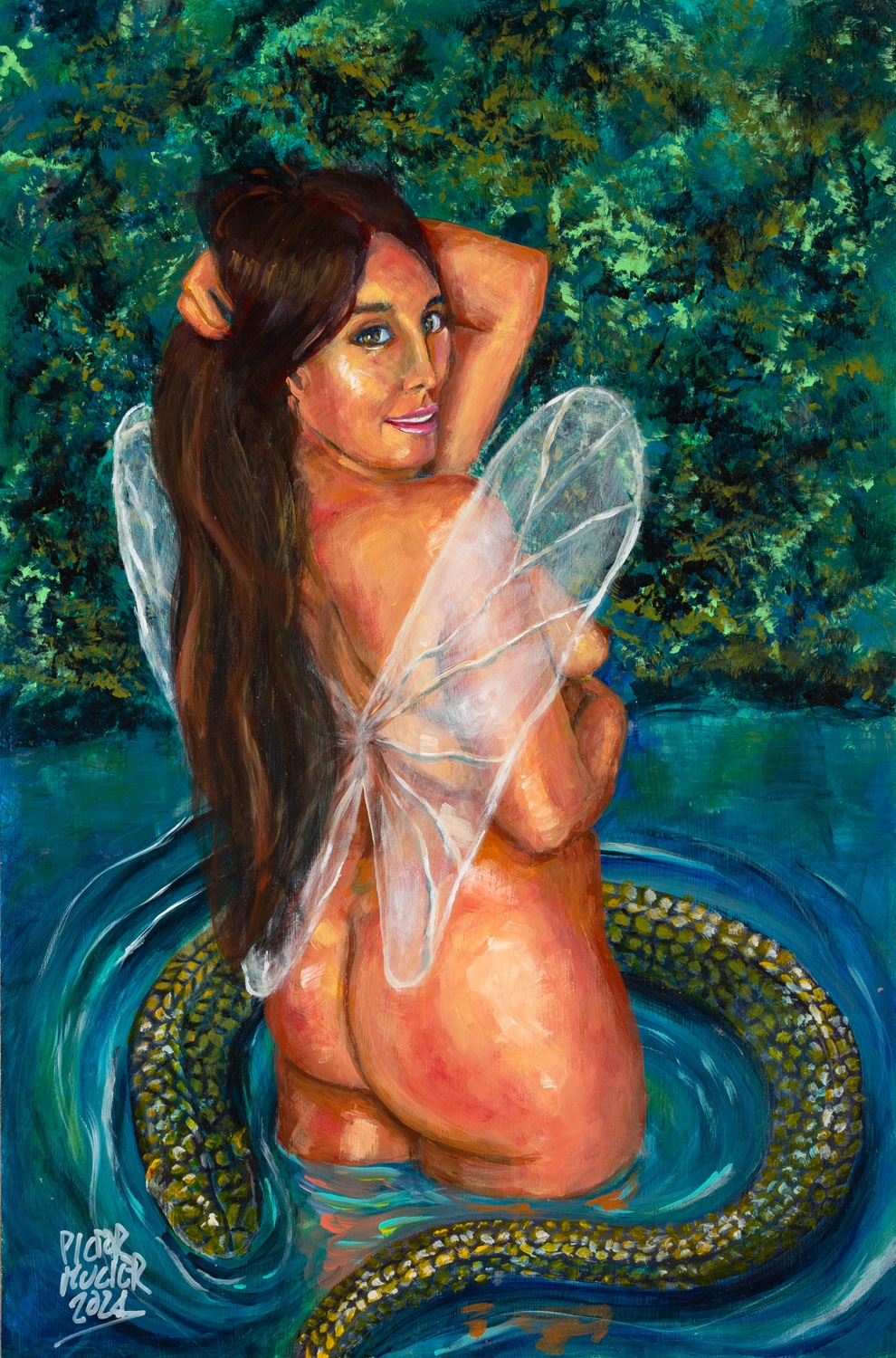
In the interview I did not elaborate further on that work, yet I did say something decisive: every painting has its own story. In this case, that story is articulated through a faerie imagination that does not erase eroticism, but renders it subtler and more cultivated. Nudity does not appear severed from its environment, but integrated into an atmosphere of enchantment. The figure is not merely displayed: she appears.
Some paintings are born of tension, others of enchantment. Leina belongs to the latter lineage. Her sensuality is neither violent nor theatrical; it is enveloping. She does not propose a closed allegory, but she does offer an evidence: that fantasy can be a form of intimate truth.
The dancers and the imaginary world of the witches’ sabbath
In the interview, I also spoke of Diosas danzando who wished to be painted dancing as though they were a kind of witches in a sabbath. The work presents two nude bodies in motion, linked by a choreography of arms, torsos, and inward gazes, against a vibrant chromatic background that intensifies the sensation of trance.
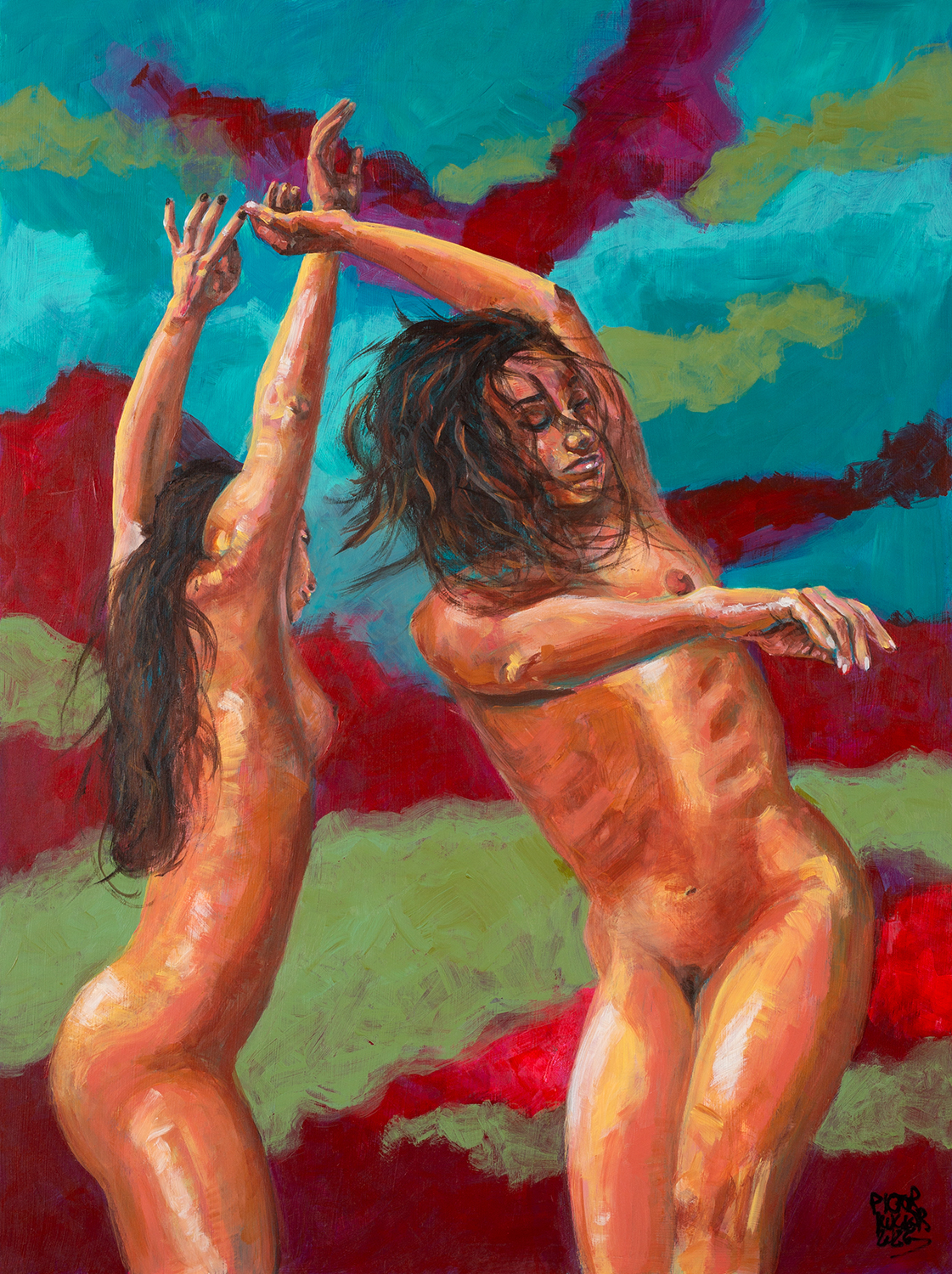
Here eroticism shifts toward rhythm, toward ceremony, toward a shared energy. It is not the isolated body that sustains the image, but the relation between two presences that seem to invoke something which does not need to be explained in order to be felt. The painting moves between dance and incantation, between sensuality and a form of archaic power.
The reference to the sabbath should not be read as superficial folklore. There is in it a serious intuition: that of a space in which the female body ceases to be contemplated from the outside and becomes an active center of intensity, desire, and metamorphosis.
To provoke or to invite reflection
One of the most direct questions in the interview was whether I seek to provoke the viewer or to convey a message. My answer was clear: I do not seek to provoke. What I seek is that whoever looks at the paintings may reflect upon themselves, upon their sexuality, upon eroticism.
I know, of course, that these images may seem provocative. To deny it would be naive. Yet a work may provoke without provocation being its ultimate purpose. In my case, it is not a matter of scandalizing, but of opening a space of consciousness. What interests me is that the viewer becomes aware of their own gaze, that they perceive what attracts them, what unsettles them, what fantasies they recognize, what prejudices they activate, what freedom they grant themselves or deny themselves.
Eroticism, when it deserves the name, is not reduced to immediate excitation. It is also a form of knowledge. It reveals regions of desire, identity, and imagination that rarely appear with such sharpness.
Censorship, reception, and readings of my work
In the interview, I explained that the reactions to my painting have been very diverse. I have suffered censorship with relative frequency: social media profiles of mine have been shut down. Yet I have also received very positive reactions, especially, and this seems significant to me, from many women.
Some have even gone so far as to tell me that I am a feminist painter. I do not use that expression here as a slogan or as a convenient label, but as testimony to a specific reception. If some women have read my work in that way, it is because they have perceived in it something other than the visual exploitation of the nude. They have seen, perhaps, that behind these figures there is an attentiveness to female fantasy, to its symbolic power, to its imaginative autonomy.
Censorship, by contrast, tends to operate with a coarse gaze. It confuses nudity with obscenity, eroticism with thoughtlessness, intensity with threat. Yet erotic art belongs to a long, complex, and noble tradition. It requires discernment. And that is precisely why it continues to unsettle: because it compels us to look where many would prefer to simplify.
What emotions I hope for when I exhibit my paintings
When I was asked what emotions I hope for when exhibiting my paintings, I answered that, beyond aesthetic emotion, I would like there to be women who feel reflected in the fantasies I am painting. That they might think: I am not the only one who wishes to be Medusa, or a fairy, or to be nude in a museum of the Vatican.
That answer contains something essential about my painting: the desire for recognition. It is not enough for me that the painting be admired; I want it to be inwardly inhabited by whoever contemplates it. That someone may discover themselves within it. That someone may realize that their imagination, however singular it may seem, is not alone.
Art can legitimize secret regions of sensibility. It can say, through images, what many people have not yet found a way to formulate.
Future plans: to go on painting with no other justification than delight
The final part of the interview turned toward the future. I said then that my plans involve continuing to do what I love. And when I was asked what I hoped to achieve, I answered that what I seek is simply to enjoy what I do and that people may enjoy what they see. And if they do not wish to enjoy it, then they need not look.
There is no disdain in that answer, but rather a certain ethic of freedom. For me, painting is not a programme of respectability. It is a vital practice. A form of fidelity to my own imagination. A discipline of visual pleasure and independent thought.
Perhaps that is why my paintings persist in nudity, symbol, and fantasy: because there I find a truth that requires no external justification. Art is not always obliged to demonstrate. At times, it is enough for it to reveal itself.
Frequently asked questions about the interview and the work of Pictor Mulier
What inspires Pictor Mulier to paint nude women?
As he explains in the interview, what inspires him is desire: his own and that of the women themselves.
What does the female body mean in his painting?
In his work, each body represents a fantasy, whether that of the painter himself or of the model. Each painting has a different story.
Does Pictor Mulier seek to provoke with his paintings?
No. He states that he does not seek to provoke, although he recognizes that his works may be provocative. His intention is to invite reflection on sexuality and eroticism.
What reactions has he received to this kind of painting?
He has received very varied reactions: from censorship on social media to highly positive responses, especially from women.
What does he hope the public will feel before his paintings?
He hopes that, besides an aesthetic emotion, some people, and in particular some women, will feel reflected in the fantasies represented by the work.