
Throughout history, artists have chosen the subjects they worked on under the pressure of needing to sell their work. In other words, most artists created works intended for the market. A market that existed in a specific time and place, and that defined which subjects were acceptable and how they were to be treated.
Even so, many artists developed intimate bodies of work inspired by their own desires, making their way while ignoring the market and, almost always, being ignored or rejected by that same market. Yet those works were created. Good examples are Goya’s private albums, Degas’ brothel paintings, or Duncan Grant’s 422 explicit erotic drawings, which for decades were believed destroyed and had circulated secretly from hand to hand until they resurfaced in 2020.
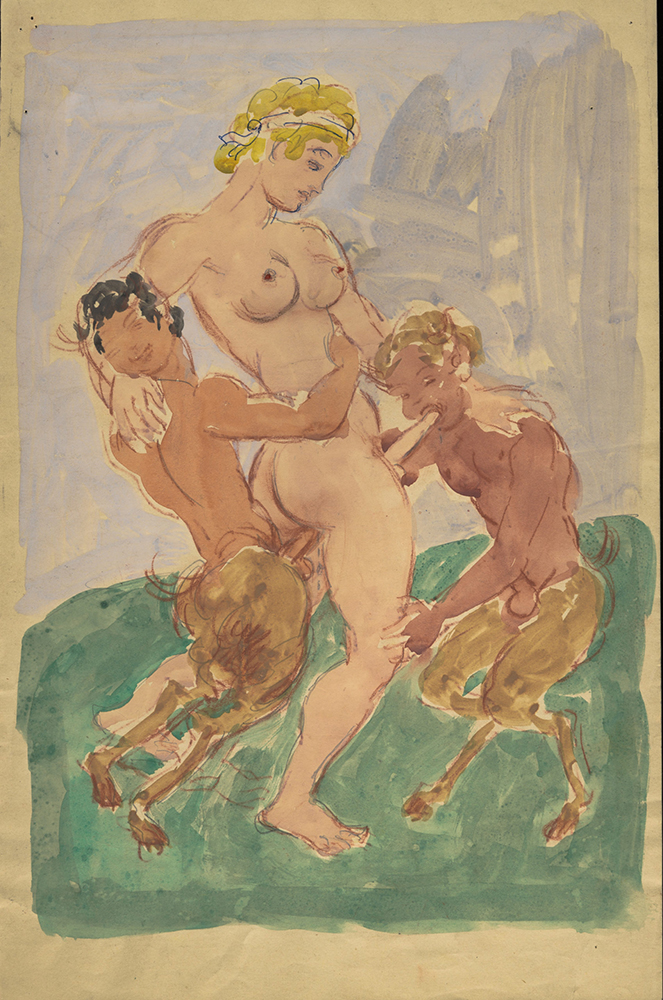
Duncan Grant. Untitled.
Today—and I acknowledge that the sociocultural context of where I live makes it easier—artists no longer need to hide what we truly wish to create. We can do so, of course, while accepting that the market may not like it. That is each artist’s decision.
I have made mine.
Does the market shape artistic inspiration?
Without a doubt, yes. Any artist who hopes to make a living from their art will be shaped by economic necessity. If they create works the market does not buy, they will not be able to live from their art. And if they create works aimed at the market, they are letting their inspiration be shaped by the desires and tastes of others.
An artist who, for whatever reason, is able to create in absolute freedom, regardless of whether the market accepts their work or not, is an artist whose works are born of absolute freedom, because their inspiration is as free as the artist themself.
What is desire in art?
Desire in art is the emotional and erotic force that drives an artist to create a work, and it can also involve the person depicted and the one who contemplates the work.
Because desire does not belong only to the artist; it also belongs to the subjects of the work and, of course, to the person who acquires it.
The artist’s desire for another person may inspire them, for example, to paint that person. That person’s desire to be portrayed in an erotic moment creates a unique dialogue with the painter: the very energy of the work. And the viewer who acquires it does so because, beyond formal considerations, the work also awakens their desire.
Why has desire been a source of artistic inspiration throughout history?
Because erotic desire is part of the human experience through which we explore the body, pleasure, beauty, intimacy, and freedom.
Erotic desire is, by its very nature, a powerful trigger of fantasy in almost all human beings. And for artists, our art is the vehicle we use to channel everything that inspires us and transform it into a work of art. Many do not use art to express their desires, but some of us do.
It is this—our human condition—that has, for centuries, driven artists to create works with erotic content.
Desire does not only choose the subject: it also transforms the artist’s gaze
Turning toward one’s own desires or the desires of others in order to create a work of art is an intimate act that changes the way one sees and understands oneself and others.
It is an enriching, passionate, and stimulating act. The artist becomes charged with their own energy and with that of the person represented, who takes on the role of co-creator. An energy that drives the creative act and is reflected in the work.
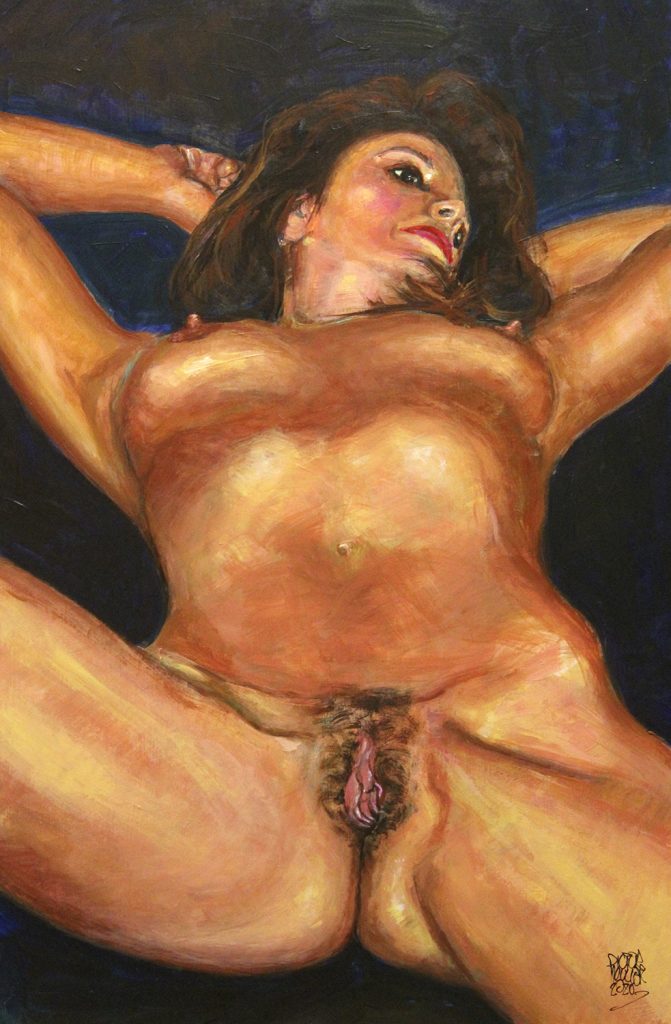
Portrait of Sarah | 40×60 cm
When a work born from the sum of desires comes into public view, it always finds viewers who see their own fantasies reflected in it. It is, therefore, an art that changes the one who creates it, the one who is represented, and the one who looks at it.
Are desire, eroticism, nudity, and pornography the same thing?
It is the eternal question, especially in the art world.
Who decides where the boundary lies between eroticism and pornography? But perhaps that should not be the question. Perhaps the real question is this: can the pornographic—understood as the representation of explicit sex—be art? Or does the subject, once certain cultural limits have been crossed, override the execution and cancel it out?
I believe the answer is personal. Desire, eroticism, nudity, and pornography are concepts shaped by each person’s experiences, environment, culture, and convictions..

Leina pleasuring herself | 40×60 cm
In my work, as a reflection of my convictions, I blend all these concepts in order to create paintings that defend each person’s right to freely enjoy their erotic desires, their own nudity and that of others, and, of course, the representation of explicit sex.
I believe it is unnecessary to compile a list of works of art that were once declared immoral and are now proudly exhibited in museums and art galleries. That alone proves that the limits of what is socially acceptable are constantly evolving.
When desire inspires, what is the artist really seeking?
I suppose one would have to ask each artist individually, but if I extrapolate from my own desires, I imagine that what we seek is to satisfy those desires by channeling them through our mode of expression, which is art.
Desire as affirmation, not as shame
And this is the key point. Why should we feel ashamed of our desires? Who believes they have the right to tell us what we may and may not desire? Religious leaders? Politicians?
I do not accept it. And not only do I not accept it, I rise up against the very fact that someone believes they possess enough moral authority to interfere in my desires and in the way I turn them into art.
I affirm my right to desire. I affirm my models’ desire to desire. And I state, unequivocally, that we feel no shame whatsoever about what we do. Quite the opposite: we feel the pride of living our lives as we choose. Of enjoying life

Lufa’s selfie | 60×80 cm
Why does this vision of desire remain uncomfortable today?
In our sociocultural environment—Spain in the twenty-first century—which is undoubtedly very similar to that of other European countries with Christian roots, this discomfort stems from a long tradition of demonizing sex. Religious powers and, more recently, political ones insist on imposing codes of behavior that exclude you if you fail to comply. They “cancel” you, as people say now. And they do so using language loaded with contempt, legitimized by their supposed moral authority.
When desire appears as a sovereign affirmation of one’s own body and one’s own pleasure, alarms go off, because such desire is a cry of freedom. And although freedom is always on their lips, the truth is that freedom terrifies those in power.
An undomesticated desire is a crack in their authority—one that may cause it to collapse.
What makes people uncomfortable is not sex: what makes them uncomfortable is the freedom with which some people—and especially women—choose to live it and show it. It is uncomfortable when there is no shame. It is uncomfortable when no permission is asked. It is uncomfortable when the body is not presented as guilt or as merchandise, but as a territory of imagination, empowerment, and freedom.
Desire is therefore pursued not only by religious or political authorities, but today also by algorithms designed by those very people who are so afraid of others’ freedom.
That is why defending desire as a creative force remains uncomfortable: because it means denying others the right to dictate what may be desired, what may be shown, and what may become art.
My painting and desire as a creative force
For an artist, the sources of inspiration are infinite. Some artists are inspired by nature, by social commitment, by the beauty of an ordinary scene, by daily life, or by futuristic fantasies. All these sources inspire works of art that go on to shape what we call artistic genres in every medium of expression: realism of everyday life, science fiction, still life, portraiture, historical art…
Well then, my genre is the erotic desire I feel for the women I paint. A desire born from my personal admiration for them. From my respect. A desire that combines with their own desire to be seen and admired. A desire they claim with courage and pride.
My work is born from that sum of desires.
And if, as Freud said—and as my Muse Paula reminded me recently—life is the constant tension between Eros (the life drive, love, and creation) and Thanatos (the death drive, rest, and destruction). t
Then I choose Eros.