
Why my models choose to be observed
For far too long, we have been taught that the gaze cast upon the female body is, by definition, suspicious. To look would be to dominate. To be looked at, to yield. To contemplate a nude would almost always amount to consuming it. And yet this reading, though born of a legitimate critique of centuries of objectification, is no longer sufficient today. Not because oppression has disappeared, but because there are women who have chosen to conquer that territory rather than abandon it.
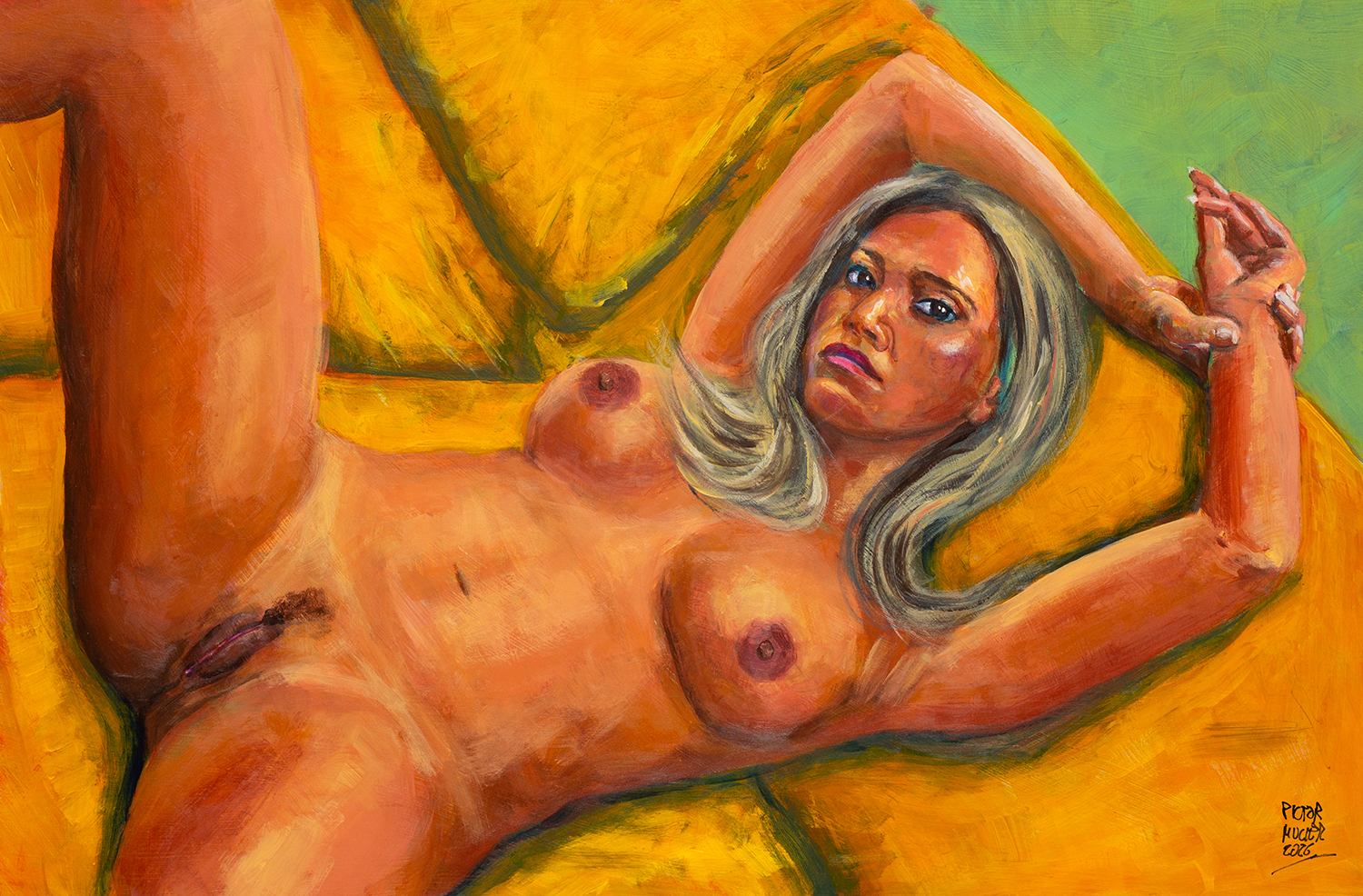
That is what happens in my painting. My models do not appear as bodies caught off guard by someone else’s gaze, nor as presences resigned to becoming images. On the contrary, they appear as women who know they are being observed and who have decided that such observation will no longer be an ambush, but a stage of sovereignty. They do not hide. They do not apologize. They do not ask for moral indulgence. They reveal themselves because they wish to. And within that gesture there is more political force than many apparently radical discourses are willing to admit.
The gaze is not always a theft
There is a critical tradition that has interpreted the representation of the female nude as a long history of appropriation. And it is not wrong. Western art has produced countless images of women designed to satisfy the visual fantasy of others: silent, docile, motionless bodies; anatomies offered to an implicitly male viewer; figures who do not assert themselves, but instead allow themselves to be consumed.
But reducing every gaze to plunder is a simplification. There is a fundamental difference between a gaze that intrudes and a gaze that has been granted permission; between an observation that turns a person into an object and one that recognizes a will within her; between predatory voyeurism and the reverent contemplation of a woman who has chosen to be seen and admired. The problem is not that a body is seen. The problem is whether that body can decide how, why, and from what position it wishes to be seen.
My models inhabit precisely that second space. They do not enter painting to be used symbolically. They enter it to affirm themselves. Some do so through pride, others through tenderness, others through a serene ferocity; but in all of them the same operation takes place: transforming exposure into a conscious act. Where imposed shame once stood, a form of authority now appears.
Being looked at can also be a choice
We live in a culture full of contradictions. Women are invited to exhibit themselves, yet punished if they enjoy that exhibition. The female body is celebrated aesthetically, yet any woman who says she feels powerful when looked at is immediately regarded with suspicion. Nudity is tolerated as long as it remains under someone else’s control, but it becomes disturbing when it expresses a desire of its own.
That is why I care so deeply about painting women who not only accept visibility, but claim it. For here an essential reversal takes place. We are no longer in front of a passive figure trapped within the frame, but before a presence that uses the frame to amplify her own will. The body ceases to be a territory colonized by the gaze of others and becomes instead a surface of declaration.
This unsettles many people. It is easier for them to understand a naked woman if she appears as a victim, as an allegory, or as mere aesthetic matter. What is harder for them to accept is a woman who knows herself to be desirable, who enjoys her own visibility, and who does not need to justify that enjoyment morally. But that discomfort in others does not invalidate her freedom; on the contrary, it makes that freedom all the more necessary.
The nude as affirmation, not submission
There is a decisive difference between posing and asserting oneself. To pose, in its most conventional sense, can mean adapting oneself to an expectation. To assert oneself, by contrast, means inhabiting one’s own body fully and turning it into language. That is what I seek in my work: not the production of a compliant nude, but the appearance of a woman who offers herself to the gaze while reaffirming her power.
When a model chooses to be portrayed nude with that awareness, the act ceases to be decorative. It becomes intellectual, carnal, symbolic. Nudity is no longer a mere absence of clothing: it is a position taken. The body no longer says, “look at me because you can,” but rather, “look at me because I allow you to.” That difference changes everything.
And it also changes the experience of the viewer. Whoever contemplates such a work can no longer settle comfortably into the logic of visual consumption. They must confront another kind of presence. A presence that returns the gaze, even if not literally. A presence that does not allow itself to be fully possessed. A presence that says: you may observe me, but you may not reduce me.
Reclaiming the pleasure of being seen
There is one idea that continues to provoke discomfort: that a woman may take pleasure in knowing herself contemplated. And yet why should that be illegitimate? Why should the desire to reveal oneself always be interpreted as alienation, and never as play, power, eroticism, or affirmation?
In my artistic universe, that pleasure exists and deserves respect. I am not speaking of empty exhibitionism, subjected to algorithms or commercial dictates, but of a chosen presence. Of women who turn visibility into a form of writing about themselves. Of bodies that do not appear in order to be approved, but to be intensely true.
There is a profound dignity in that gesture. The dignity of one who does not deny her own eroticism. The dignity of one who does not separate beauty from desire as though one ennobled and the other degraded. The dignity of one who understands that being admired is not the same as being subjected, just as desiring is not the same as obeying. My painting is born precisely at that intersection between art and sexuality, lived without hypocrisy.
Painting in order to restore sovereignty
I have always believed that art can do more than simply represent beautiful bodies. It can correct imaginaries. It can contest symbols. It can restore density, complexity, and authority to figures who, for centuries, have been stylized for the desire of others. That is why my works do not attempt to domesticate female erotic force, but to give it a space in which it may unfold with intelligence, pride, and freedom.
When I paint a naked woman, I do not seek to strip her of mystery, but to protect the mystery she has chosen to reveal. I do not want to turn her into flat evidence, but into full presence. Her body does not appear as visual merchandise, but as a form of sovereignty.
In that sense, every painting is also a cultural argument. A response to those who still believe that female freedom is only legitimate when it does not disturb. An objection to the old habit of accepting the representation of the female body only if it is filtered through guilt, distance, or symbolic correctness. I prefer another path: that of conscious beauty, of desire without servitude, of the woman who chooses to appear because she knows that appearing can itself be a form of power.
Looking in another way
Perhaps the task is not to forbid the gaze, but to educate it. To learn how to look without appropriating. To learn how to contemplate without reducing. To learn to recognize that some bodies are not there to be consumed, but to affirm a will. The question is not to abolish visibility, but to transform its meaning.
This also requires a more honest viewer. Someone capable of accepting that eroticism does not cancel dignity, that explicitness does not annul depth, and that a naked woman can be, at the same time, an object of aesthetic admiration, a subject of desire, and the author of her own presence.
My models choose to be observed because they have understood something essential: the gaze of others does not always have to be a prison. Sometimes it can be a conquered space. A stage for affirmation. A field in which shame retreats and, at last, a luminous form of sovereignty appears.
I therefore defend the right to the gaze. Not the right to invade, nor to appropriate, nor to degrade. I defend the right of a woman to decide that she wants to be seen and to transform that visibility into an expression of power, pleasure, and freedom. And I also defend the right of art to accompany that decision without apologizing for its intensity.
For there are bodies that do not beg for permission to exist.
There are women who do not wish to hide either their beauty or their desire.
And there are paintings that are not made to soothe morality, but to remind us of a truth more uncomfortable and more beautiful: that a woman may offer herself to the gaze without ever ceasing to belong entirely to herself.